

An airport transfer is a private transportation service pre-arranged based on flight information, operating door-to-door with a chauffeured vehicle. The passenger is met at the airport and taken directly to their hotel or address. Unlike a taxi, it does not work on demand but by reservation. For our guests landing at Antalya Airport (AYT), an airport transfer is the most predictable way to reach areas such as Belek, Side, Kemer, Alanya, Kundu, Kaş, and Kalkan.
In this article, we explain the concept itself: how it works, what types exist, why it makes a difference for a guest arriving in Antalya, and how to evaluate it for your own trip. Reservation steps and current prices are not the subject of this article; for those, we direct you to our more practical, hands-on content.
Table of Contents
- What is an airport transfer and how does it work
- Transfer types: private, shared, and VIP
- Why it matters for guests arriving in Antalya
- How to evaluate it for your own trip
- Frequently Asked Questions
- Your next decision
What is an airport transfer and how does it work
An airport transfer is the service of picking up a passenger from the airport and taking them to a hotel, holiday resort, home, or business address; and often, at the end of the holiday or business schedule, bringing them back to the airport from the same point. Because of this second leg, the service is generally referred to in two formats: one-way (arrival only or return only) and two-way (round trip).
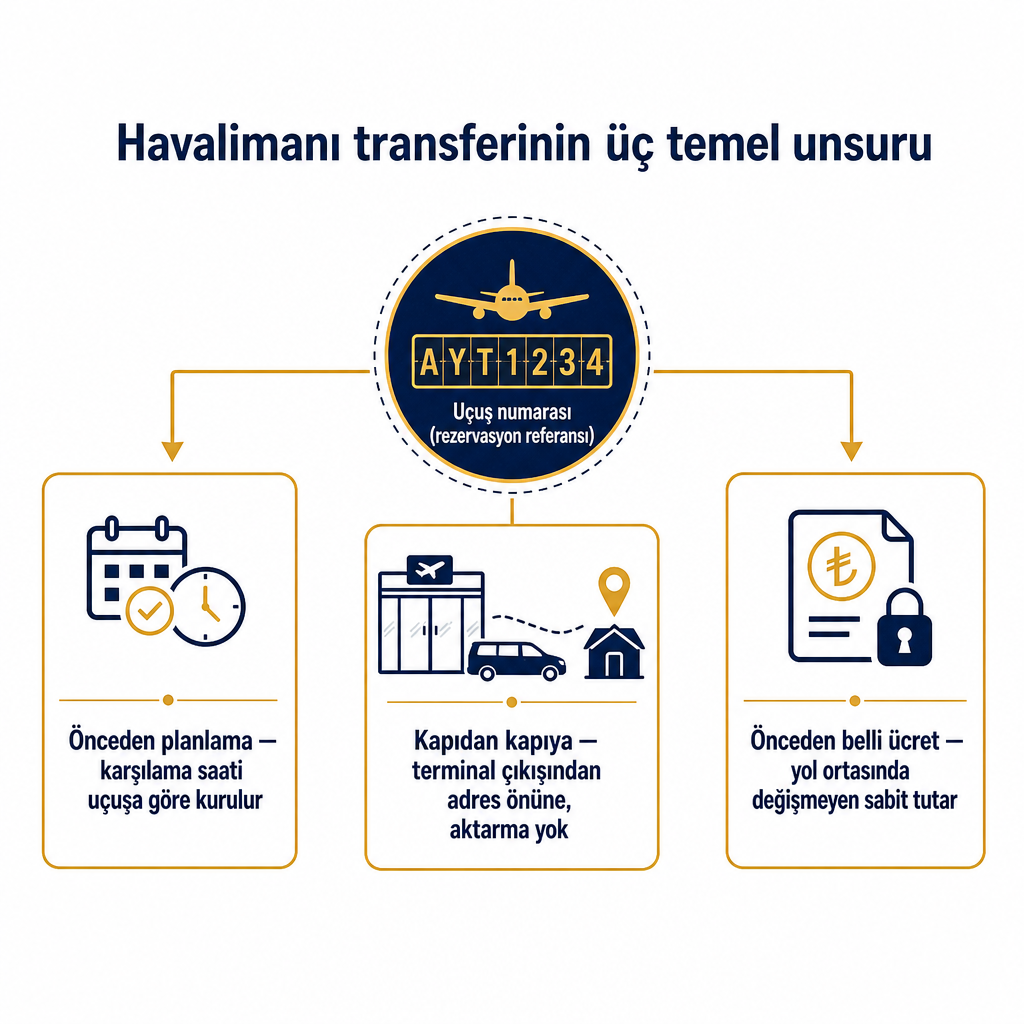
At the heart of the mechanism lies a single piece of data: the flight number. The flight information shared during the reservation is the reference point that organizes the rest of the service. The time the driver will be ready at the airport, the meeting point, and the waiting plan are all established based on this information. We work with the same logic and track flights; if the landing time is moved up or there is a delay, we adjust our welcome plan accordingly. When the passenger leaves the airport, there is no need to search for a vehicle, wait in line, or negotiate a price.
The second distinguishing element is the phrase "door-to-door." The transfer starts at the terminal exit and ends in front of the accommodation address. No transfers, no intermediate stops, no moving luggage from one vehicle to another. The difference between boarding a city bus with three suitcases after a long flight and simply walking up to the vehicle determines how the first hours of the holiday are spent.
The third element is that the price is known in advance. With a reserved transfer, the fee is defined from the outset based on distance and vehicle class; there are no taximeter or peak-hour surprises. Our model is also built on transparent and fixed pricing: our guest knows what they will pay when reserving the vehicle. Since the figures vary depending on the route and vehicle class, that is a separate matter; the key point here is that the amount does not change mid-journey.
These three elements complement one another. The flight number fixes the timing, the door-to-door service fixes the route, and the fixed price fixes the cost in advance. When all three come together, the number of decisions the passenger has to make upon arrival drops to zero; this is precisely what sets a transfer apart from a taxi or public transport.
A frequently confused concept: "transfer passenger"
In aviation terminology, a "transfer passenger" refers to a passenger who connects at another airport to reach their final destination. This is not the same as an airport transfer in ground services. One describes a plane-to-plane connection, the other describes road transportation from the airport to an address. Since the two concepts often appear side by side in search results, it is useful to clarify the difference. In practice, a passenger can experience both situations on the same trip: arriving in Antalya on a connecting flight and, after the terminal, continuing to their hotel via a road transfer.
Transfer types: private, shared, and VIP
An airport transfer is not a single service but the collective name for several formats. The difference between them has less to do with the brand of the vehicle than with who the vehicle is allocated to and who determines the timing.
Private transfer. The vehicle is reserved exclusively for you and your companions. The departure time is set according to your flight, and there are no stops along the route to pick up other passengers. This is the format preferred by those who want calm, privacy, and direct arrival.
Shared transfer (shuttle). Multiple guests travel in the same vehicle; the service operates according to specific times and specific stops. It is a conceptual alternative for passengers who do not want to deal with public transport but who prioritize budget. The natural consequence is this: the vehicle's route is built not around a single hotel but around all passengers' hotels. This means the arrival time depends on variables outside your control.
VIP transfer. This is the private transfer offered with a higher standard of comfort. The journey is personalized, only the relevant passenger or group is in the vehicle, the time is arranged according to the passenger's needs, and the vehicle class is selected from the upper segment. This is our focus: we operate our VIP transfers departing from Antalya Airport with Mercedes Vito and Mercedes Sprinter vehicles, on a 24-hour basis. For our guests who want to see in more detail the difference between vehicle classes in terms of passengers and luggage, the page where we introduce our VIP transfer vehicle fleet is a more suitable starting point.
The choice between these three formats actually comes down to your answer to two questions: should the vehicle be allocated to you, and who should determine the time. In the shared format, the service plan answers both; in the private and VIP formats, you determine both. What sets VIP apart from private is the higher step in vehicle class and welcome standard.
There is a misconception to be aware of here: the idea that an airport transfer is entirely a luxury-segment service. The category is a spectrum ranging from the shared format to private vehicles and VIP service. The word "transfer" does not define a price level but a pre-planned, chauffeured form of transportation. Which segment you choose is a decision related to the size of your group and the level of comfort you expect from your trip.
A second common misconception is the assumption that a taxi is more practical in all circumstances. A taxi certainly has a flexibility for on-demand transport. However, with a reserved transfer, the driver is ready according to the landing time; the stages of searching for a vehicle, waiting in line, and negotiating the route are eliminated. During peak season and at night, this difference reveals itself as a predictable timeline.
A third point of distinction is group size. Even within the same category, vehicle class varies according to the number of people and luggage volume: a trip for two people and a family of six require a different vehicle setup under the same service heading. For this reason, format selection and vehicle selection are two consecutive decisions; first the form of service, then the capacity within that form.
Why it matters for guests arriving in Antalya
What makes a transfer important in the context of Antalya is distance. The distance between the airport and the holiday regions requires very different planning from a fifteen-minute journey to the city center. Kundu is relatively close, Belek and Side are further away, and Alanya, Kaş, and Kalkan are routes measured in hours. The journeys of two guests leaving the same airport can be two completely different experiences. To see which region means a journey of what scale, looking at the transfer regions we serve is a good starting point.
On top of these distances come flight times. A significant portion of the scheduled and charter flights arriving in Antalya land close to midnight or in the early hours of the morning. Searching for transportation at midnight, in a foreign city, tired and burdened with luggage, is the most fragile moment of a trip. Having the vehicle waiting for you, reserved in your name, removes that moment from being a problem. This is exactly why we have built our service on a 24/7 basis: the flight time is not an exception but a normal part of the planning.
Families with children
Two technical needs stand out in family travel: child safety and luggage volume. For a family with small children, having an appropriate child seat ready in the vehicle is not a detail to be sorted out later but a precondition of the journey. A stroller, beach equipment, and suitcases packed for two weeks require vehicles with large luggage capacity such as the Vito and Sprinter. We provide child seats in our vehicles upon request and offer free Wi-Fi so children can be entertained on long routes. Having screen access on a ninety-minute journey may seem like a small comfort detail, but it makes a difference felt throughout the trip. If you inform us in advance of your child's age and the number of children, we can prepare the appropriate seat type before the journey.
Corporate guests and event attendees
On a business trip, the priority is punctuality. For a guest who needs to make it to a meeting, a congress, or an event, transportation is not a flexible but a fixed element of the schedule. A VIP vehicle with a professional driver meets both the timing and the corporate appearance side at once. The Wi-Fi in the vehicle turns the journey from dead time into productive time for a passenger who wants to clear their emails before reaching the hotel. For event attendees arriving as a group, providing us with the date, number of people, and destinations is enough for us to plan the appropriate vehicle setup together.
International guests
Language magnifies small tasks upon first landing in a new country. Explaining the hotel address, discussing the route, or agreeing on a fee is an unnecessary burden for a tired passenger. With a pre-planned transfer, none of these conversations are necessary: the address is recorded in the reservation, and the route and fee are set. For our guests curious about how VIP transfers departing from Antalya work in practice region by region, our guide covering destinations, primarily Belek, Side, and Kemer, offers a more detailed framework.
How to evaluate it for your own trip
The right transfer is not the most expensive or the cheapest one, but the one that fits your travel profile. The following questions are not a ranking but criteria for weighing your own situation.
How many people are you traveling with and how much luggage? A business trip for two with light luggage and a family holiday for six with six suitcases require different vehicle classes. Thinking of capacity not by the number of people but by the sum of people plus luggage gives a more accurate result. Bulky items such as golf equipment, diving gear, or a stroller are also part of the equation.
Do you want the vehicle allocated exclusively to you, or is sharing acceptable? This preference determines both the arrival time and the experience you have throughout the journey. For guests with small children, those arriving at night, or those wanting to go directly to the hotel, a private vehicle is generally a more comfortable choice.
At what time does your flight land and is there a risk of delay? For midnight landings and long connecting flights, whether the provider tracks the flight is decisive. In a service that monitors the landing time by flight number, a delay does not mean the welcome plan collapses.
Is the welcome process clearly defined? Where you will be met, whether there is a driver waiting with a name sign, and whether help will be provided with luggage are small but concrete details that shape the experience. A vaguely left welcome arrangement can turn into twenty minutes lost at the terminal exit.
Is the provider legally authorized? In Turkey, commercial passenger transport is an activity requiring an authorization certificate; the most frequently cited document in tourist transfers is the D2 authorization certificate. Working with a licensed company with a clear corporate identity also carries meaning in terms of insurance coverage and liability. For the details of the subject and which documents cover which activity, our article covering the D2 certificate and the documents required for transfers is a more comprehensive resource. Since regulatory details can be updated, we recommend that you also verify your specific situations from official sources.
Are the price and conditions in writing from the outset? A fixed price is not just knowing the amount; it is knowing what is included. The scope of the fee, the waiting conditions, and change scenarios should be clarified at the time of reservation. On our side, the amount and scope are clearly shared when reserving the vehicle.
Which region are you going to? The difference in distance between Kundu and Kalkan affects both the vehicle selection and the route plan. On long routes, seat comfort and a rest-stop plan become topics that rarely come up on short routes. For our guests coming to the Manavgat and Side area, our blog guide prepared specifically for the region offers a more local perspective; the full list of the points we serve is on our destination page.
It is more useful to read these criteria together rather than one by one. For most guests, two of them stand out: group size and landing time. Once these two become clear, the vehicle class and welcome plan are largely determined on their own; the remaining headings serve to fine-tune the details. If you are not sure which criterion weighs most in your own list, send us your date, number of people, luggage situation, and destination; let us prepare a recommendation for the vehicle class and welcome setup that suits you.
Frequently Asked Questions
What is the difference between an airport transfer and a taxi?
The fundamental difference is in the planning. A transfer is arranged in advance based on your flight number; the driver is ready according to the landing time, and the fee and route are known from the outset. A taxi, on the other hand, is an on-demand service: you have to find the vehicle at the terminal exit, the fee is calculated during the journey, and there is a possibility of waiting during peak hours. With a transfer, the vehicle is also selected in advance according to your number of people and luggage.
Who is a VIP airport transfer suitable for?
For guests who want the vehicle allocated entirely to them: families with children, those arriving late at night, those going to long-distance regions, and corporate travelers with a fixed schedule. In the VIP format, the journey is personalized, the time is set according to the passenger's needs, and the vehicle is selected from the upper segment. We provide this service departing from Antalya Airport with Mercedes Vito and Sprinter vehicles.
What advantages does it provide for families with children?
Three concrete points stand out: the child seats we provide upon request, the large luggage capacity of the Vito and Sprinter vehicles, and free in-vehicle Wi-Fi. Door-to-door transport is added to these; that is, you do not have to carry suitcases and the stroller at transfer points. It is enough to inform us of your child seat need and your children's ages at the time of reservation.
What happens to my transfer if my flight is delayed?
Since we track flights, we monitor changes in the landing time via your flight number. We adjust our welcome plan according to the actual landing time; the same logic applies when the flight lands early. We clearly share the conditions regarding waiting time at the reservation stage.
Why are authorization certificates like the D2 important?
In Turkey, commercial passenger transport is an activity subject to authorization, and the most frequently cited document in tourist transfers is the D2 authorization certificate. Working with a licensed company makes a difference in terms of the insurance coverage of the vehicle and passenger and on the liability side. For details about document types and their scope, you can refer to our D2 article on our blog; for questions specific to your own situation, it is also advisable to obtain confirmation from official sources.
How far in advance should I plan my transfer?
The general approach is not to wait after your flight ticket is confirmed. Since the availability of the appropriate vehicle class can narrow during peak season, night arrivals, and for large groups, early planning leaves a more comfortable range of choices. If you send us the date, number of people, luggage situation, and your destination, let us determine the suitable setup together.
Your next decision
At this point, the decision has come down to a few concrete pieces of information: how many people are you coming with, which region are you going to, and at what time does your flight land. With these three data points, the vehicle class and welcome plan become clear. If you are looking for region-based detail, our guide prepared for the Manavgat and Side area offers a more local framework; if you want to see all the points we serve, you can review our VIP transfer destinations. If you would like to discuss your transfer, all you need to do is send us your flight information, number of people, and destination; let us plan the suitable option together.