

When choosing the right hospital for medical tourism in Antalya, most travelers look for a single name; yet the real decision is identifying which hospital type best fits your treatment profile and travel plan. This comparison clarifies the differences between university and public training hospitals, large private general hospitals, regional private hospitals in resort areas, and specialty centers that focus deeply on a single field, without ranking them. Our goal is to show which alternative makes more sense in which situation, and to make the transportation link from the airport to the hospital a part of this decision. As a travel agency providing VIP transfers from Antalya Airport to Belek, Side, Kemer, Alanya, Kundu, Kaş, and Kalkan, we also address the logistical side of the treatment decision in concrete terms.
Table of Contents
The official framework of medical tourism in Antalya
A choice made without knowing which hospital can legally accept foreign patients remains risky regardless of the quality of treatment. In Turkey, this field is regulated by the Regulation on International Health Tourism and Tourist Health, which imposes an International Health Tourism Authorization Certificate requirement for both healthcare facilities and intermediary organizations.
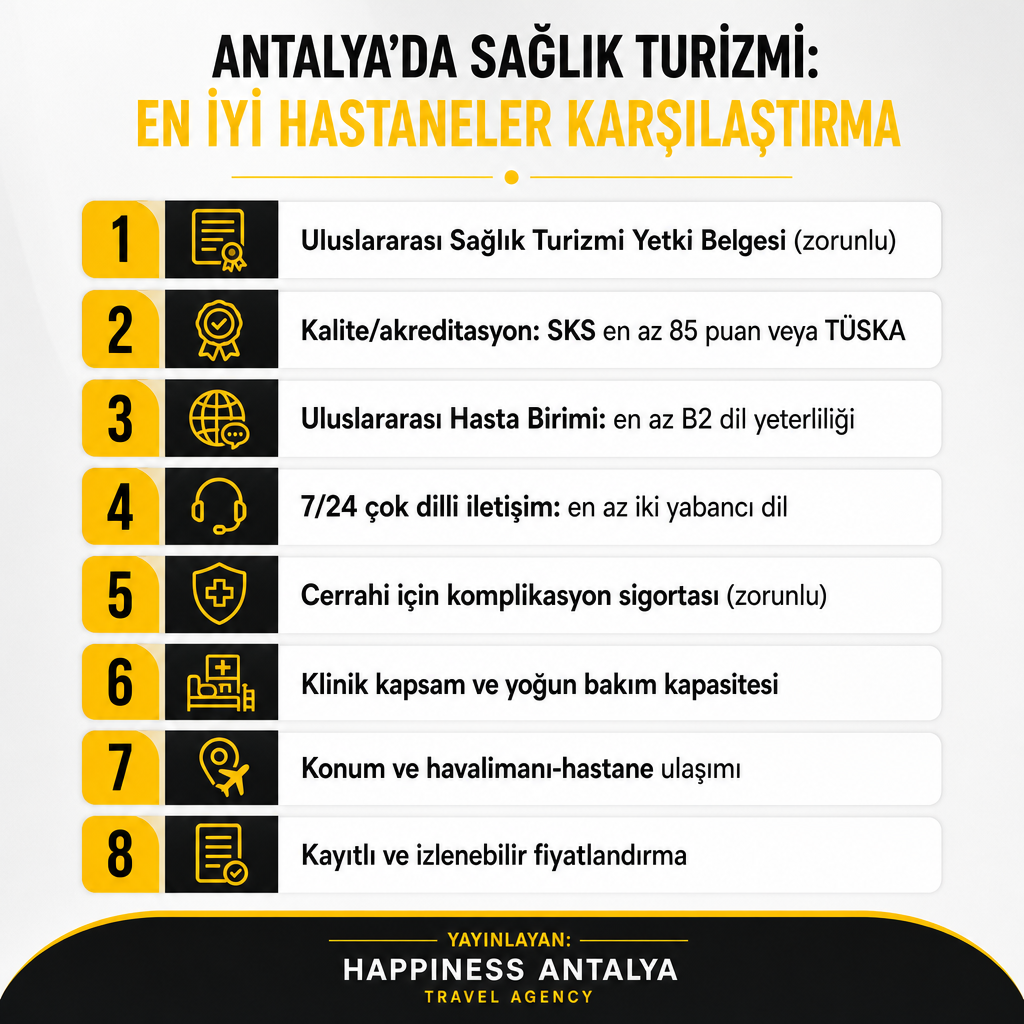
The basic conditions set by the regulation serve as benchmarks for understanding whether a hospital is ready for medical tourism. If surgical procedures are to be performed on a foreign patient, the relevant facility must obtain complication insurance. An International Patient Unit or Health Tourism Unit must be established within the institution, and this unit must include staff with foreign language proficiency of at least B2 level. In addition, hospitals engaged in medical tourism are expected to score at least 85 points in the Health Quality Standards assessment or to document their quality level through TÜSKA accreditation.
Within this framework, Antalya has a strong infrastructure; the presence of 2 universities, 18 public, and 28 private hospitals in the city shows that genuinely different options exist depending on the type of treatment. The Provincial Health Directorate regularly updates the list of facilities and intermediary organizations that have obtained the authorization certificate. The practical conclusion is this: having heard the name of a hospital is not enough; verifying whether that institution is on this official list is the first step of the decision.
Hospital types suitable for medical tourism
Instead of searching for the "best hospital," comparing hospital types according to your own treatment and travel profile is a more accurate approach. Each of the four alternatives below has strengths and weaknesses within its own context; we are not ranking them.
University hospitals and public training and research hospitals are strong in terms of academic infrastructure, scientific research capacity, and the management of complex cases. Since most are subject to Ministry of Health quality assessments, they can meet the medical tourism authorization criteria. Examples that establish a health tourism unit offer special processes and language support for foreign patients; the Kepez State Hospital Health Tourism Unit in Antalya is a typical example of this.
Large private general hospitals are multidisciplinary complexes that can provide services across a wide range such as cardiology, oncology, organ transplantation, orthopedics, and aesthetic surgery, housing numerous intensive care units and operating rooms. Due to their proximity to tourism centers, they accept patients from different countries, and when they have an international health tourism unit, they can develop 24/7 communication in foreign languages, travel coordination, and package programs.
Regional private hospitals in resort areas are located in holiday resorts such as Alanya, Side, and Kemer, offering services at a closer distance to guests staying in hotels. They generally focus on frequently demanded fields such as dentistry, aesthetics, ophthalmology, and obesity surgery. The location advantage constitutes a practical alternative for those who want to plan sea and nature activities between treatments.
Private specialty centers and clinics, on the other hand, offer a high level of expertise in a single field; such as dentistry, aesthetic surgery, or IVF. When they obtain the authorization certificate, they can establish packages for foreign patients and multilingual patient relations management. However, due to their limited bed and intensive care capacity, they are not always ideal for complicated or multi-disease cases.
Main criteria you can use when deciding
Basing the choice on evidence-based criteria reduces your risk and makes your vacation plan more predictable. The headings below are based on official legislation and medical tourism practices.
- International Health Tourism Authorization Certificate: It is the prerequisite for providing services to foreign patients; without this certificate, medical tourism activity cannot be carried out in Turkey, and the requirement applies to both private and public hospitals as well as intermediary organizations.
- Quality and accreditation: TÜSKA accreditation shows that patient safety and care quality are above national standards. For hospitals within the scope of medical tourism, at least 85 points are required in the Health Quality Standards assessment.
- International Patient / Health Tourism Unit: The regulation requires the establishment of a special unit within the institution. In this unit, at least one staff member must have 65 points in YDS/YÖKDİL or a B2-level foreign language certificate; this is critical to prevent misunderstandings in doctor-patient communication.
- 24/7, multilingual communication infrastructure: Organizations serving foreign patients are expected to have a communication infrastructure that is accessible uninterrupted in at least two foreign languages. This infrastructure provides rapid coordination in flight changes, emergencies, and post-treatment complications.
- Complication insurance and surgical safety: Complication insurance is mandatory for surgical procedures to be performed in an operating room environment; this clarifies the financial and legal framework in unexpected medical problems.
- Clinical scope and intensive care capacity: For patients with multiple chronic diseases or those undergoing complex surgery, a large number of intensive care beds and specialists from different branches are essential; whereas for simple aesthetic or dental procedures, a strong specialty center may be sufficient.
- Location, transportation, and tourist integration: Large hospitals in the city center are close to the airport and the city network; while hospitals in Alanya, Side, and Kemer facilitate the treatment-vacation combination with a short driving distance to hotels.
- Price transparency and payment terms: The authorization certificate process keeps organizations under official registration and supervision, ensuring that pricing is traceable.
Comparison table: which alternative for which profile?
The table below compares the four hospital types criterion by criterion without commercial ranking; its purpose is not to declare a winner, but to make visible the alternative that matches your profile.
| Criterion | University & Public Training | Large Private General | Resort Area Private | Specialty Centers & Clinics |
|---|---|---|---|---|
| Authorization certificate potential | High (public supervision) | High (tourism-specific structure) | Medium-high | Variable by specialty |
| International patient unit | Limited but expanding | Widespread, multilingual teams | At regional scale | Small teams |
| Clinical scope | Broad, suitable for complex cases | Very broad, advanced surgery | Strong in specific branches | Deep in a single/few branches |
| Tourist integration | Compatible with city tourism | City and congress tourism | High with sea-resort | Compatible with short mini vacations |
| Transportation need | Transfer to city center | Airport-hospital critical | Longer transfer time | Varies by location |
When A, when B, when none?
The same hospital is suitable to different degrees for different patient profiles. Three typical scenarios illustrate how the decision changes.
Scenario 1: An adult with multiple diseases planning complex surgery
If multiple chronic diseases and advanced surgery are involved, a university or public training and research hospital offering an academic team and a broad intensive care network is a strong option. At the same level of complexity, if you are looking for more personalized room comfort, private nursing service, and a tourism-focused international patient unit, a large private general hospital stands out. In cases where the treatment is fully covered by the public system in your country of residence and going abroad brings additional financial and legal risk, coming to Antalya only for vacation may be more rational.
Scenario 2: A person who wants to combine aesthetic surgery or dental treatment with a vacation
If you want to stay in Alanya, Side, or Kemer and combine a beach vacation with a short-term procedure, and prioritize a very short hotel-hospital distance, a resort area private hospital is practical. If the procedure is not complicated, can be managed on an outpatient basis or with a short hospital stay, and you have found an institution offering intensive expertise in its field, a specialty center or clinic may be sufficient. If your expectations are not clear, if you are basing your choice solely on price, and if you have not verified complication insurance, accreditation, and the authorization certificate, the safest approach is to not rush into any option.
Scenario 3: A family traveling with a child or elderly patient
If you want strong intensive care and multi-branch team support against possible complications, and you prioritize proximity to the airport and city infrastructure, large hospitals in the city center are suitable. If you want to maintain children's motivation with sea and nature activities and resolve mild-to-moderate procedures during the vacation, resort area hospitals will serve. If flight times are long, weather conditions are risky, or your doctor considers flying inadvisable given the patient's current condition, postponing the plan may be medically safer.
How does airport-hospital VIP transport affect comfort and risk?
An often overlooked but critical component of the medical tourism experience is the transportation from the airport to the hospital, from the hospital to the hotel or resort area. No matter how well the treatment is planned, an uncertain transfer after a long flight disrupts both comfort and time management.
As Happiness Antalya Travel Agency, with the VIP transfer service we offer from Antalya Airport to areas such as Belek, Side, Kemer, Alanya, Kundu, Kaş, and Kalkan, we provide a predictable transportation infrastructure for health-focused travelers as well. Our spacious vehicles such as the Mercedes Vito and Sprinter are suitable for comfortably transporting medical files, extra luggage, and companion belongings. Services such as free Wi-Fi, flight tracking, and child seats increase comfort, especially for families with children and patients arriving after a long flight. Our 24/7 accessible structure allows flexible planning according to pre- and post-surgery hours.
Clarifying time, comfort, and logistics in the airport-hospital-hotel triangle in your plan reduces risks and establishes a treatment-focused trip. To review the areas we serve, you can use our VIP transfer regions and VIP transfer destinations pages. Our VIP vehicles page helps you determine your vehicle type and capacity preference according to the treatment duration and number of companions.
Structuring your health-focused trip to Antalya
Clarifying the hospital and treatment type first, and then the accommodation and transportation decisions, simplifies the process step by step. You can follow a simple flow to carry your decision to the next date.
- Narrow down the appropriate hospital type for your treatment type (university/public, large private, resort area, specialty center) according to the criteria above.
- Verify the status of the International Health Tourism Authorization Certificate, health tourism unit, accreditation, and complication insurance of the institution you have chosen from official sources.
- Take into account the distance from Antalya Airport to the hospital and the area where you will stay, the total travel time, and companion needs.
- Check out the areas we serve and the vehicle options for a transfer plan suitable for comfort and time management in the airport-hospital-hotel triangle.
If you want to combine your health-focused trip with a vacation-themed experience, the VIP Transportation for Large Groups to the Blue Flag Beaches in Alanya article on our blog provides practical ideas about regional dynamics and transportation alternatives. To see your arrival route to Antalya in advance, the distance and time information on the VIP transfer regions page also helps with planning. For a personalized transfer plan suited to your needs, you can share details such as date, area, number of people, and number of companions via our contact page.
Frequently asked questions
How do I know if a hospital is officially authorized for medical tourism?
The International Health Tourism Authorization Certificate is the basic indicator of this; per the regulation, healthcare institutions and intermediary firms without an authorization certificate cannot carry out medical tourism activity. The provincial health directorate publishes a list of authorized facilities and intermediary organizations; checking this list before your decision is the soundest step.
Is foreign language-speaking staff really mandatory?
Yes. According to the authorization certificate criteria, an International Patient Unit must be established within the institution, and at least one staff member in this unit must document B2-level foreign language proficiency. This is not a recommendation but a legally required condition.
For which procedures is complication insurance mandatory?
Within the scope of medical tourism, the regulation makes complication insurance mandatory for surgical procedures performed in an operating room environment. This assurance protects both the patient and the institution in unexpected medical problems after surgery.
Is a public hospital or a private hospital better in Antalya?
Official regulations impose quality standards, authorization certificate, and accreditation criteria for both public and private hospitals. Instead of "better," it is more accurate to decide with the criteria in this article which hospital type is more suitable for your own treatment type, complication risk, and expectations.
What should I pay attention to when making my flight plan for medical tourism?
Consider the surgery date, your doctor's fitness-to-fly assessment, the complication risk, and the transportation time between Antalya Airport and your accommodation area together. VIP transfer noticeably improves comfort and time management, especially in the post-surgery period.